
The difference between anti-spoofing and anti-jamming is fundamental for anyone designing or operating GNSS-dependent systems. Both threats can deny reliable positioning, but they do so through entirely different mechanisms. Treating them as the same problem leads to incomplete protection and wasted budget.
Defining the Two Threats
Anti-jamming focuses on overpowering or disrupting the legitimate satellite signal. A jammer transmits high-power noise or a continuous wave signal on the GPS frequency band. The receiver either saturates or loses lock because the desired signal is buried. Anti-jamming techniques aim to suppress or remove the interfering energy.
Anti-spoofing, by contrast, deals with deception. A spoofer generates a counterfeit GPS signal that mimics the real satellite constellation. The receiver locks onto the fake signal and computes a wrong position or time. Anti-spoofing techniques detect and reject signals that exhibit signs of manipulation.
Difference Between Anti-Spoofing and Anti-Jamming: Core Mechanisms
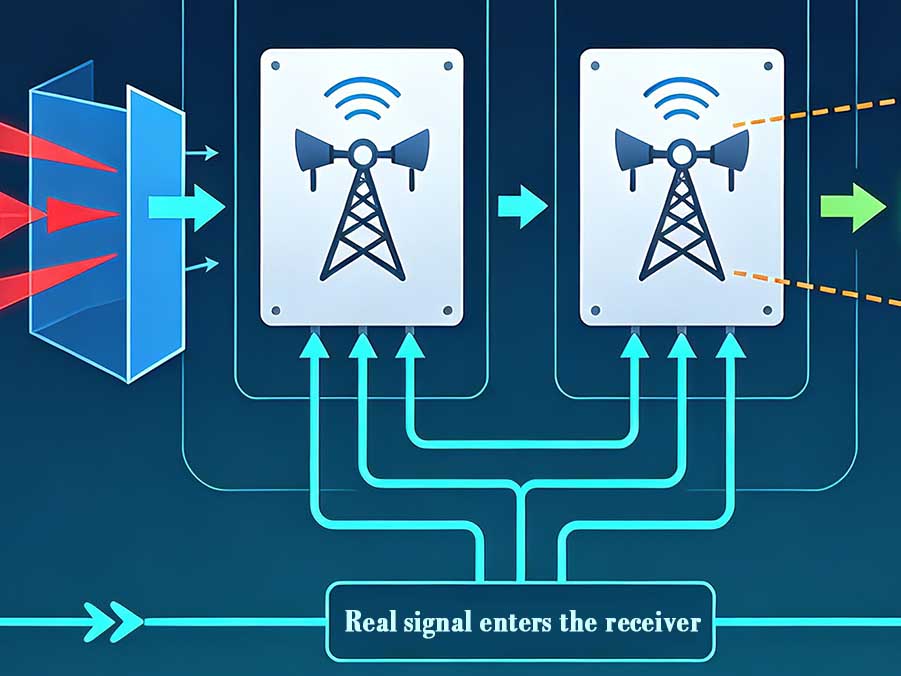
The primary difference between anti-spoofing and anti-jamming lies in the signal characteristics. A jammer is loud and obvious. A spoofer is quiet and subtle. Anti-jamming systems rely on power metrics and spatial filtering. Anti-spoofing systems rely on cryptographic authentication, signal geometry, and time consistency checks.
Another key difference is the attack duration. Jamming often lasts seconds to minutes and is relatively easy to locate. Spoofing can continue for hours without the operator noticing. A vessel could be diverted dozens of nautical miles before an alarm triggers.
Image alt text: Difference Between Anti-Spoofing and Anti-Jamming comparison chart showing attack vectors and defenses
Side-by-Side Comparison
| Aspect | Anti-Jamming | Anti-Spoofing |
|---|---|---|
| Primary threat | Denial of service via high-power noise | Deception via counterfeit signals |
| Signal power | Much stronger than real GNSS | Similar to real GNSS |
| Detection method | Power monitoring, null steering | Cryptographic checks, clock drift analysis |
| Typical hardware | CRPA array, adaptive filters | Authenticated receiver, IMU cross-check |
| Attack window | Seconds to minutes | Minutes to hours |
| User awareness | Immediate loss of fix | Silent position drift |
Why the Difference Matters for Hardware
If you are evaluating GNSS protection, the difference between anti-spoofing and anti-jamming drives your hardware selection. A high-end controlled reception pattern antenna (CRPA) excels at spatial nulling for jammers but offers little protection against a sophisticated spoofer that arrives from a direction similar to a real satellite. Conversely, a receiver with Galileo OSNMA or GPS Chips Message authentication can reject spoofed signals but will still be overwhelmed by a 10-watt jammer.
Many integrators combine both layers. For example, a CRPA front-end handles jamming, while a multi-frequency, multi-constellation receiver with authentication handles spoofing. If you are still narrowing down antenna options, see our guide on how to choose a GPS anti-jamming antenna. Understanding how CRPA antenna works also helps clarify its limitations against spoofing.
Common Misconceptions
A frequent misunderstanding is that anti-jamming features automatically defeat spoofing. This is false. Jamming is an energy attack; spoofing is an information attack. They are orthogonal problems. Another misconception is that multi-frequency receivers are inherently spoof-proof. While dual-frequency reception makes spoofing harder, a synchronized spoofer can still replicate both bands.
The industry standard for robust navigation is layered defense: antenna-based spatial filtering for jamming, plus authentication and consistency monitoring for spoofing. For detailed technical references, the GPS.gov technical documentation provides authoritative guidance.
In summary, the difference between anti-spoofing and anti-jamming is not academic. It dictates which equipment you buy, which tests you run, and which failure modes you accept. Recognizing that difference is the first step toward building a navigation system that stays trustworthy when the electromagnetic environment turns hostile.