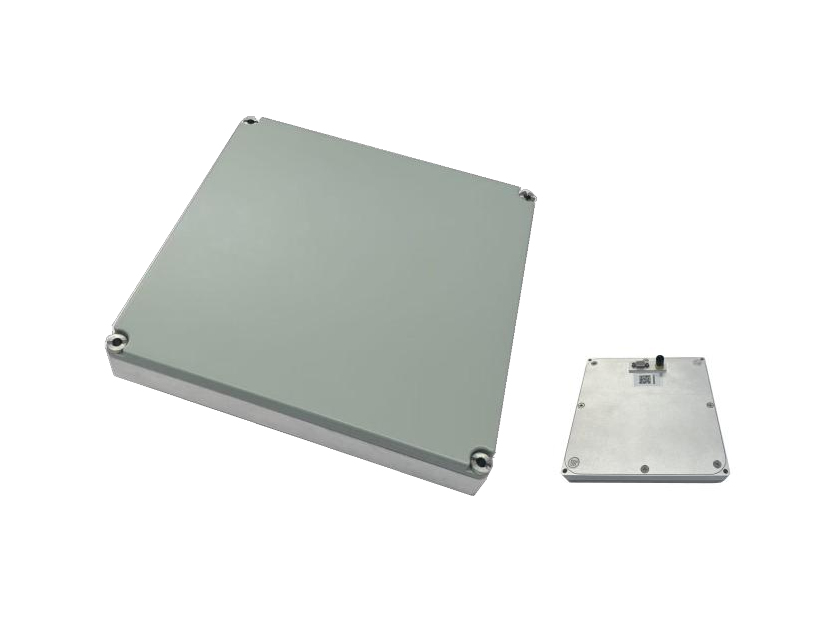
Reliable satellite navigation can fail the moment a deliberate or accidental jammer appears. That risk is exactly why the 4-element GNSS anti jamming antenna concept has become non-negotiable for drones, electronic warfare platforms, and critical communication towers. The BNTGIM-4A packs a complete multi-element solution into one lightweight chassis, removing the usual trade-offs between protection, size, and power.

All-in-One GNSS Anti Jamming System Design
Instead of cabling separate antennas to a distant processor, the BNTGIM-4A integrates a 4-array antenna, the anti-jamming engine, and a full navigation receiver on a single board. This approach shrinks phase mismatch and simplifies installation. The result is a portable 4-element GNSS anti jamming antenna that weighs just 430 grams and occupies a footprint of 132 × 132 × 20 mm. Four M3.2 through-holes on a 125 mm square pattern let you bolt it directly onto a drone airframe or a vehicle mount.
Multi-Frequency Coverage
The unit covers the four most used civil and military signals: GPS L1, BDS B1, GLONASS L1, and Galileo E1. This multi-constellation support means the 4-element GNSS anti jamming antenna preserves position accuracy even if one constellation is partially disrupted, and it enables robust timing for 5G base stations that rely on GNSS-disciplined clocks.
How the System Neutralizes Broadband and Swept Interference
Traditional filters struggle against wideband noise and fast frequency hoppers. Here, spatial processing takes over. The BNTGIM-4A shapes nulls in the direction of hostile emitters while maintaining gain toward satellites. A dedicated 4-element GNSS anti jamming antenna algorithm inside distinguishes between continuous wave, swept, pulsed, and combinations of those waveforms. It can suppress any mix of these patterns from up to three distinct directions simultaneously.
Alt text for product image: BNTGIM-4A GNSS anti jamming system with 4-element array.
Interference Suppression Capabilities
Single-source jamming is attenuated by at least 110 dB. When three independent jammers are active, the suppression stays at 95 dB or better. These figures represent the ratio between the raw interference power at the antenna and the residual level that reaches the receiver correlator. For a drone operator facing a roadside jammer, that margin keeps the control link solid. You can learn more about spatial nulling techniques from external resources such as the GPS World anti-jamming topic page. For our internal antenna lineup, see our GNSS antenna integration guide.
Compact Receiver and Proven RF Chain
The integrated receiver is a U-blox M9N, widely recognized for concurrent multi-constellation tracking and fast cold-start times. If a project requires a different chipset, the 4-element GNSS anti jamming antenna can be customized at the factory; we’ve built variants with SAW-filtered front ends and alternative receiver cores. No additional RF cabling is needed between the antenna array and the receiver, which eliminates common failure points and keeps the noise figure low.
Built for Harsh Deployments
With an input range of 9–36 V DC and a typical draw of only 12 W, the BNTGIM-4A runs comfortably from drone batteries, vehicle power busses, or solar-charged installations. The operational temperature span of –40 °C to +70 °C ensures the 4-element GNSS anti jamming antenna can be deployed from arctic regions to desert environments without heated enclosures. The sealed all-metal housing and J30J-9ZKP connector add protection against dust and humidity.
Seamless Data Output and Timing
Data comes out via RS422 at 115200 bps (configurable) using standard NMEA0183 sentences or the U-blox binary protocol. A 3.3 V LVTTL 1PPS signal on pin 9 provides a precise time reference for synchronizing radios, sensors, or industrial controllers. When operators adopt a 4-element GNSS anti jamming antenna like the BNTGIM-4A, they often find that the clean 1PPS signal stays stable even under jamming that would have completely silenced an unprotected receiver.
Straightforward Integration
Installation requires only a single 9-pin connector, making field swaps quick. The mounting pattern and low profile let the unit be recessed into wings or mast tops. Because the anti-jam processing happens inside the enclosure, no complex external calibration is needed after mechanical installation. Many integrators first test the 4-element GNSS anti jamming antenna in their lab using a simple GNSS simulator and a single jammer, then move directly to flight testing.
By combining high suppression ratios, multi-constellation reception, and a self-contained form factor, the BNTGIM-4A addresses the exact demands of modern unmanned and mobile applications. As the electromagnetic environment gets more crowded, a purpose-built 4-element GNSS anti jamming antenna stops being a luxury and becomes a baseline requirement for mission success.