
At sea, a GNSS outage is rarely just a convenience problem. It touches navigation, collision avoidance, survey accuracy, autonomous operations, and in some cases, crew safety. As jamming and spoofing incidents become more common in ports, coastal waters, and confined waterways, vessel operators are moving from passive reception to active protection. This article examines the practical landscape of marine GNSS anti-jamming solutions and how to think about them as part of an integrated navigation system.
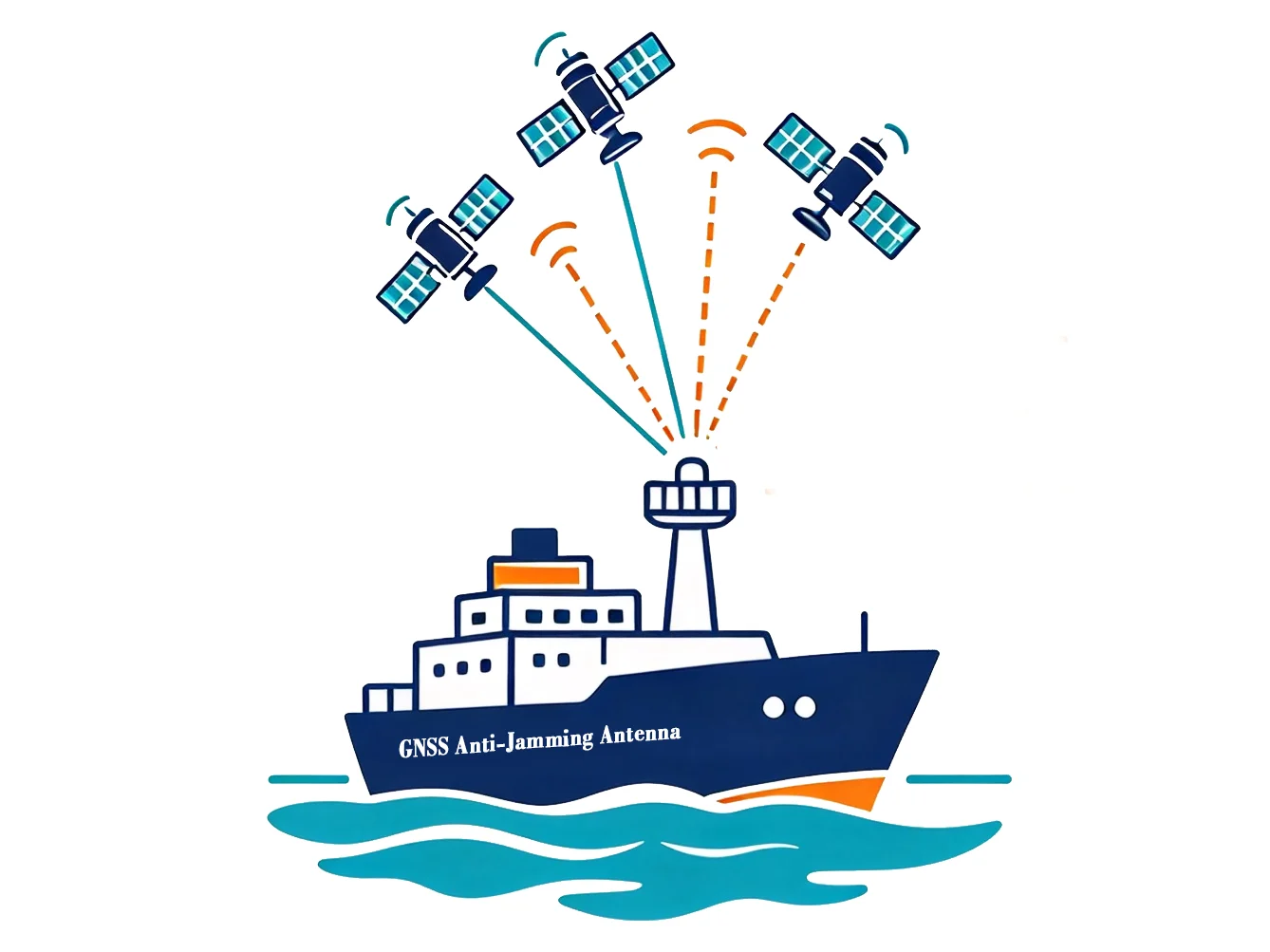
The Maritime Threat Is Not a Copy of the Land Threat
Land-based jamming often happens in dense urban or military environments. Maritime interference has its own profile. Signals can arrive from a single coastal jammer, a moving vessel, or a distributed set of sources. Multipath from the sea surface and superstructure is constant. Antenna placement is constrained by masts, funnels, radar, and other RF emitters.
Spoofing adds another layer. A spoofed GNSS signal may not cause an immediate dropout. It can slowly pull a receiver off track, creating false position or timing. For bridge teams, the first sign may be a mismatch between GNSS and radar, AIS, or visual bearings.
Key maritime interference characteristics include:
-
Long-range propagation over water with few obstructions.
-
High dynamics on fast patrol craft and ferries.
-
Low dynamics but high multipath on large ships.
-
Multiple GNSS bands used for redundancy.
-
Increasing use of GNSS for timing and synchronization.
Core Solution Architectures
Marine GNSS anti-jamming solutions generally combine antenna design, receiver processing, and system-level resilience. No single technique solves every threat. The most effective installations layer several approaches.
| Approach | What it does | Strengths | Limitations |
|---|---|---|---|
| Controlled Reception Pattern Antenna (CRPA) | Forms beams and nulls electronically | Strong against directional jammers | Cost, size, calibration complexity |
| Adaptive nulling | Places nulls toward interference | Effective for known jammer directions | Needs enough elements and processing |
| Beamforming | Increases gain toward satellites | Improves C/N0 in low-signal areas | May not handle many simultaneous jammers |
| Multi-constellation / multi-band | Uses GPS, GLONASS, Galileo, BeiDou | Adds redundancy and band diversity | Requires compatible receivers and antennas |
| Inertial aiding | Couples GNSS with an IMU | Bridges short outages and detects spoofing | Drift over longer outages |
| Spoofing detection | Monitors signal anomalies and consistency | Early warning and mitigation | Not a stand-alone cure |
A practical marine system often uses a multi-band CRPA with adaptive nulling, a multi-constellation receiver, and inertial or other sensor aiding. The antenna is the first line of defense, but the receiver and navigation software determine how well the whole chain performs.
Matching the Solution to the Vessel
Different vessels face different risk profiles. A harbor tug may need compact, ruggedized protection with simple interfaces. A naval patrol boat may need high-dynamic nulling and secure timing. A commercial tanker may prioritize long-term reliability, spare parts, and class compliance.
| Vessel type | Primary concern | Recommended emphasis |
|---|---|---|
| Commercial cargo / tanker | Reliable navigation and AIS integrity | Multi-band antenna, spoofing detection, simple retrofit |
| Ferry / passenger vessel | Safety and schedule certainty | Redundant GNSS, inertial aiding, bridge alerts |
| Patrol / naval craft | Hostile jamming and spoofing | CRPA, high-dynamic nulling, secure timing |
| Survey / offshore support | Position accuracy | Multi-constellation, precise antenna calibration |
| Autonomous / uncrewed vessel | Continuous operation | Sensor fusion, spoofing detection, remote monitoring |
The right answer is not always the highest null count. Installation space, cable runs, power budget, and maintenance access often shape the final design.
Integration Matters More Than the Datasheet
A marine GNSS anti-jamming antenna can perform well on a test range and still underperform on a vessel. Integration factors include:
-
Antenna placement away from radar and communication antennas.
-
Ground plane and mast structure effects.
-
Cable loss and connector quality.
-
Calibration for the installed environment.
-
Receiver compatibility and firmware maturity.
-
Alarm logic for the bridge team.
For example, an adaptive antenna that requires a specific calibration file may need a controlled installation procedure. If the crew cannot repeat that procedure after maintenance, performance may degrade silently.
Testing and Validation at Sea
Laboratory testing is essential, but marine validation should include realistic conditions. Useful test scenarios include:
-
Single-tone and broadband jamming from different bearings.
-
Spoofing that pulls position gradually.
-
Multipath from nearby structures and the sea surface.
-
Operation with radar and VHF transmitting simultaneously.
-
Sudden outage and recovery while under way.
Validation should record not only technical metrics but also bridge usability. If an alarm is confusing or a recovery takes too long, the solution is incomplete.
Operational and Lifecycle Considerations
Marine electronics face salt, vibration, temperature swings, and long maintenance intervals. A robust solution should address:
| Area | Practical question |
|---|---|
| Environmental sealing | Will the antenna survive salt spray and deck wash? |
| Connectors | Are they marine-grade and field-serviceable? |
| Spares | Can critical modules be replaced without dry docking? |
| Firmware | How are updates validated and deployed? |
| Training | Can the crew interpret jamming and spoofing alerts? |
| Documentation | Are installation and calibration records complete? |
These factors influence total cost of ownership as much as the initial hardware price.
What to Expect in the Next Few Years
Marine GNSS anti-jamming solutions are becoming more software-defined. We are likely to see tighter fusion between GNSS, inertial, radar, and visual navigation. Machine learning may help classify interference and spoofing faster. Antenna arrays may become smaller and more power-efficient, making them practical for smaller vessels.
At the same time, jamming and spoofing techniques will continue to evolve. The goal is not permanent immunity, but a resilient navigation architecture that can detect, mitigate, and recover. For vessel operators, the most important step is to treat GNSS protection as a system requirement, not an accessory.
Final Thoughts
Marine GNSS anti-jamming solutions are no longer limited to military or high-value assets. Commercial operators, ports, and autonomous vessel developers are all assessing how to keep position and timing trustworthy. The best results come from matching the antenna, receiver, and integration to the actual threat and platform. When that alignment is done well, the vessel keeps navigating even when the RF environment turns hostile.