Introduction
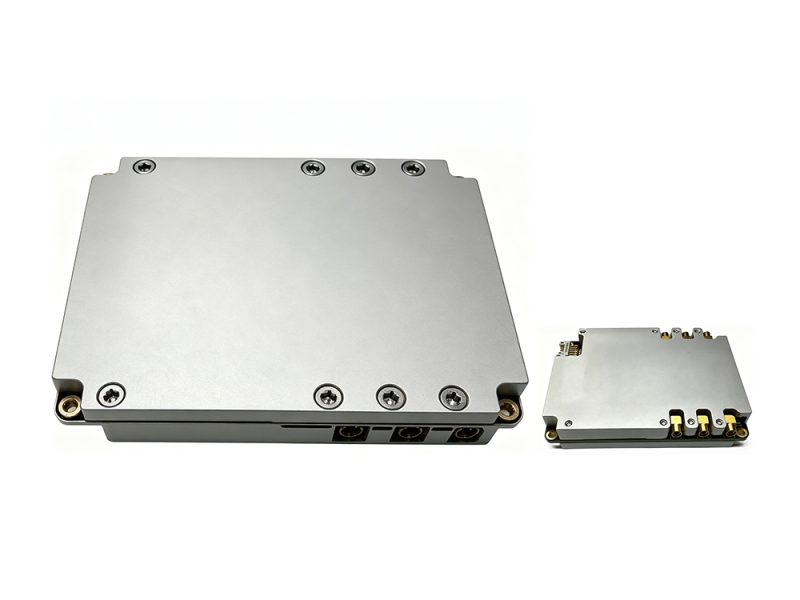
The BNTFBAT four-channel anti-jamming antenna is a board-level GNSS interference processor built for unmanned systems, small vehicles, and portable navigation gear. It takes four RF inputs from an antenna array, suppresses intentional or accidental jamming, and feeds one clean signal to the receiver. The design focuses on low cost, light weight, and reliable operation in complex electromagnetic conditions.
Frequency Bands and Mode Switching
This four-channel anti-jamming antenna processor offers dynamic band configuration through five selectable modes. M0 covers L1/B1 from 1559 to 1606 MHz, M1 targets L2 at 1227.6±1 MHz, M2 handles L5/B2a at 1176.45±12 MHz, M3 locks B2b at 1207.14±10 MHz, and M4 processes B3 at 1268.52±10 MHz. Operators can switch modes to match the active constellation, whether GPS, BDS, or both.
Jamming Suppression Performance
The BNTFBAT four-channel anti-jamming antenna nulls up to three jammers coming from different directions at the same time. Single-jammer rejection stays above 110 dB, while three simultaneous jammers are suppressed by more than 95 dB. It handles broadband, narrowband, pulsed, swept, and combined suppression-style interference. Input AGC tolerates up to +10 dBm per channel to avoid front-end saturation.
Power and Data Interfaces
The unit runs on 5–14 VDC and draws 10 W typical. Data communication uses RS422 or UART at LVTTL levels through the JL126-2-12ZJW connector. One GPI pin and one GPO pin support external blanking or status signaling. The single RF output provides a processed signal between -70 and -40 dBm, compatible with most GNSS receivers without extra attenuation.
Compact Mechanical Design
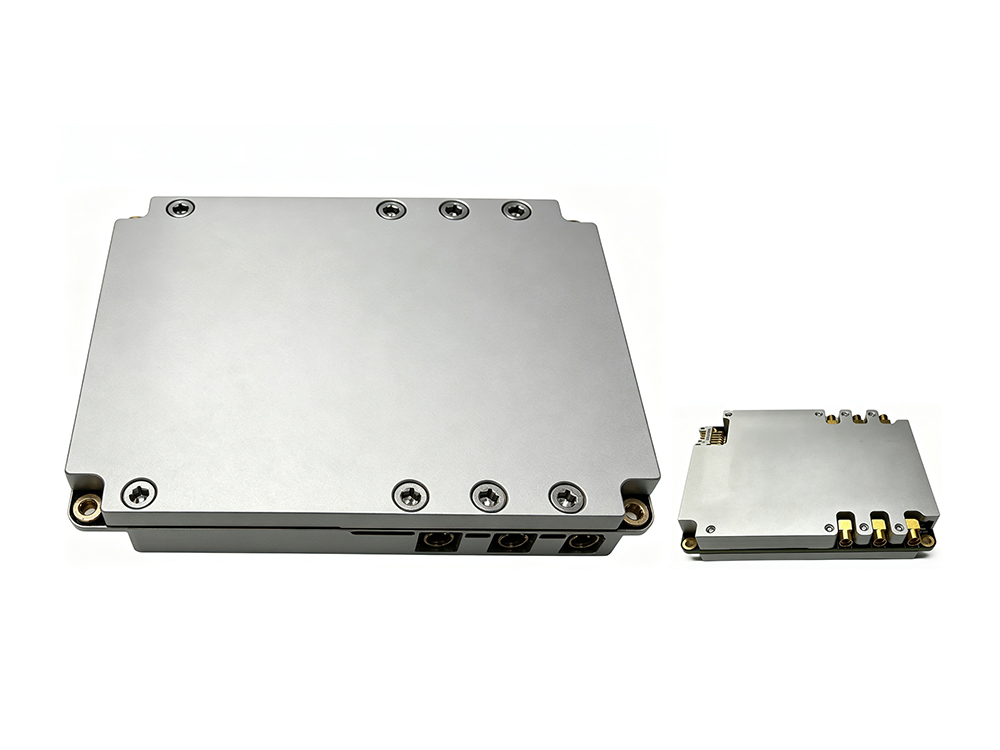
At 62 g and 70×54×11±0.5 mm, this four-channel anti-jamming antenna processor fits easily inside drone payload bays, ground robots, and small enclosures. Four Φ3.2 mm mounting holes spaced 65×49 mm simplify mechanical integration. The low-profile board can be stacked with receiver modules or embedded into custom housings.
UAV and Field Applications
Drones often operate near jammers or high-power transmitters that disrupt GNSS locks. The BNTFBAT four-channel anti-jamming antenna processor maintains position and timing data when L1, L2, L5, B1, B2, or B3 bands are attacked. Its 10 W power budget and featherweight build are especially attractive for battery-powered aircraft and portable timing systems.
What Makes BNTFBAT Different
Unlike bulky rack-mounted anti-jam units, this four-channel anti-jamming antenna processor squeezes 110 dB single-jammer rejection into a credit-card-sized board. Mode flexibility, built-in AGC, dual serial outputs, and GPIO control reduce integration effort. For more on GNSS interference, see GPS.gov.
Installation Essentials
Keep all four RF input cables matched in length and phase for accurate spatial nulling. Mount the board away from switching regulators and high-current traces. Apply 5–14 VDC to pin 2 or 8, ground pin 1 or 7, and verify RS422 or UART output before mission use.
Connector Pinout