
Interference can overwhelm GNSS receivers. A jammer raises the noise floor and hides weak satellite signals. An anti-jamming antenna fights back before the receiver loses track.
It does not block everything. It separates wanted signals from unwanted energy. Then it attenuates the interference using spatial, spectral, polarization, and digital techniques.
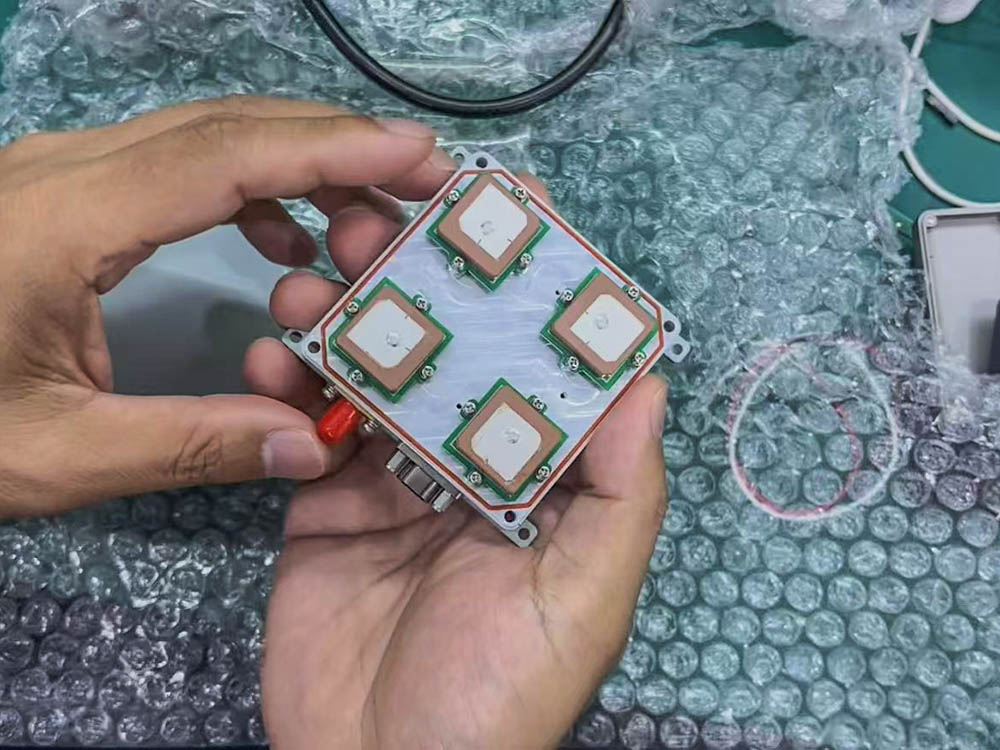
Spatial Filtering Comes First
The strongest defense is spatial. Many anti-jamming antennas use an array of two or more elements.
A jammer arrives from one direction. Satellite signals arrive from others. Because array elements are spaced apart, the same wave reaches each element at slightly different times.
The processor measures those phase differences. It estimates direction of arrival. Then it applies complex weights to each channel and sums them.
Correct weights create high gain toward satellites and low gain toward jammers. This is adaptive nulling. For array fundamentals, see how a CRPA antenna works.
Beamforming and Nulling Are Different
Beamforming and nulling often appear together. They are not the same.
Beamforming improves weak GNSS signals. It shapes the main lobe toward satellites. Nulling reduces strong interference. It places deep nulls toward jammers.
A system with M elements can usually form up to M−1 independent nulls. Calibration quality and algorithm speed determine real performance. More elements mean more freedom, but also more size, cost, and power demand.
Filtering Adds Another Layer
Spatial processing is powerful, but it is not the only tool. RF filters remove energy outside the GNSS band.
A band-pass filter blocks strong out-of-band transmitters. A notch filter targets a known narrowband interferer. These filters protect sensitive receiver components from saturation.
In-band interference is harder. If a jammer occupies the same frequency as GNSS, filtering alone cannot remove it without damaging the satellite signal. Spatial nulling becomes essential.
Polarization and Digital Processing
GNSS signals use right-hand circular polarization. A jammer with linear or opposite polarization can be attenuated by a polarization-selective antenna.
This defense is not perfect. A smart jammer can match GNSS polarization. Then digital processing must help.
After analog-to-digital conversion, algorithms examine time, frequency, and spatial domains. Fast Fourier transform excision removes narrowband tones. Adaptive notch filters track changing interferers. Subspace projection separates signals using statistical differences.
Where the Techniques Fit
| Technique | How It Suppresses Interference | Best Against | Main Trade-Off |
|---|---|---|---|
| Adaptive nulling | Places low-gain nulls toward jammers | Directional jammers | Needs accurate calibration |
| Beamforming | Increases gain toward satellites | Weak GNSS signals | Limited null capacity |
| Frequency filtering | Rejects out-of-band energy | Adjacent-band jammers | Cannot remove in-band noise |
| Polarization filtering | Attenuates wrong-polarization signals | Cross-polarized interference | Jammer may match GNSS polarization |
| Digital excision | Removes interference in time or frequency | Pulsed and narrowband jammers | Adds latency and processing load |
Practical Limits Matter
Real performance depends on hardware, not just algorithms. Calibration stability, RF linearity, dynamic range, and latency all shape results.
A null that drifts away from the jammer is useless. A filter that distorts satellite signals can weaken tracking. Platform reflections and cable phase changes can also distort the array response.
Testing therefore combines anechoic chamber measurements, live-sky trials, and controlled jamming.
The Goal Is Margin, Not Magic
No anti-jamming antenna defeats every scenario. The hardest case is a wideband, in-band, co-polarized jammer from the same direction as a satellite.
Spatial nulling may then reduce satellite gain too. The practical goal is a higher jamming margin.
That margin gives the receiver room to track, calculate, and hold timing. Without it, even brief interference can cause loss of lock. Layering also covers gaps that any single method leaves open.
By layering adaptive nulling, beamforming, filtering, polarization control, and digital processing, an anti-jamming antenna keeps GNSS receivers working where a conventional antenna would fail.