
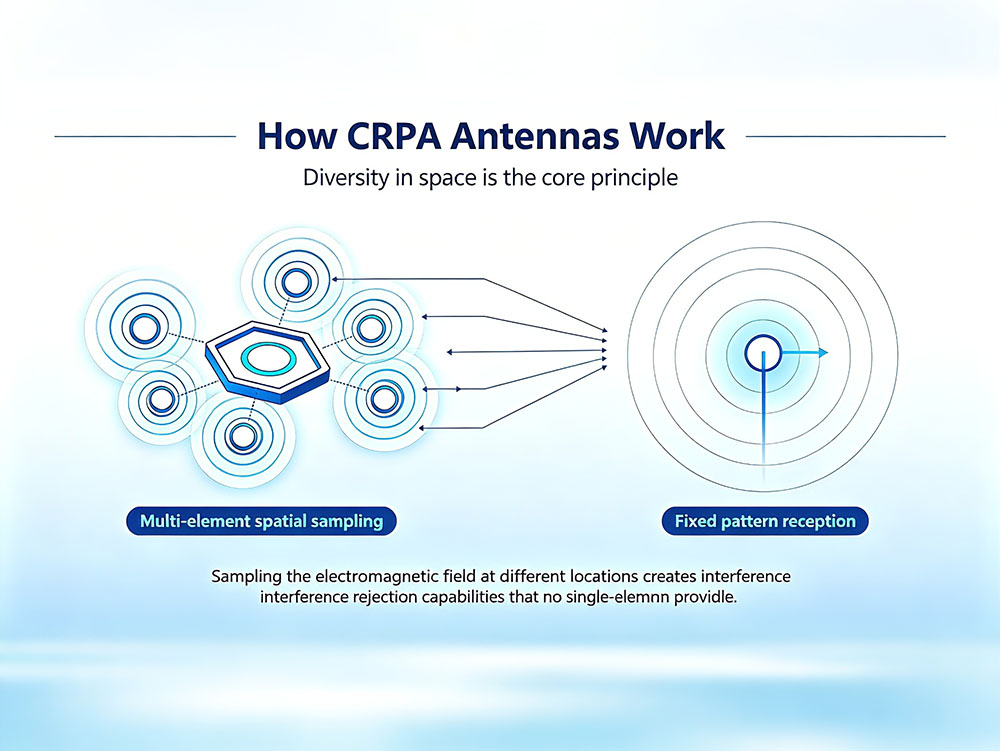
How CRPA antenna works is rooted in spatial diversity. Unlike a fixed reception pattern antenna (FRPA) that listens equally in all directions, a CRPA uses multiple elements to sample the electromagnetic field at slightly different points. This spatial sampling enables electronic protection against jamming that no single-element antenna can offer.
Core Array Geometry
A typical CRPA has 4 to 7 elements arranged on a ground plane. Most designs place a central reference element surrounded by a ring of auxiliary elements. The distance between elements is usually half a wavelength at the L1 frequency, about 95 mm. This geometry ensures that a jamming signal arriving from a specific direction produces a different phase shift at each element, while desired satellite signals spread across many angles. To understand how CRPA antenna works at the physical layer, think of the array as a spatial filter that samples incoming wavefronts at discrete points.
How CRPA Antenna Works: Null Steering
The central task is adaptive null steering. After each element converts the RF signal to an intermediate frequency, the digital backend computes complex weights. These weights adjust the phase and amplitude of each element’s signal before summation. The processor identifies a strong interfering signal by its high power and directional consistency.
Then it iteratively adjusts the weights to create a spatial null—a sharp reduction in gain—in the direction of the jammer. The combined output attenuates the jammer by 40 dB to 60 dB, while satellite signals from other directions remain largely intact. The exact answer to how CRPA antenna works depends on the algorithm: minimum variance distortionless response (MVDR) preserves gain in the satellite direction while minimizing total output power.
Digital Backend Processing
The digital backend is the brain of the system. It must operate fast enough to track moving jammers, with typical update rates from 1 kHz to 10 kHz. Space-time adaptive processing (STAP) adds time taps to handle wideband or pulsed jammers. The backend also performs calibration to correct for element mismatches, which otherwise limit null depth. If you are still evaluating hardware options, see our guide on how to choose a GPS anti-jamming antenna.
CRPA vs. FRPA at a Glance
| Characteristic | FRPA | CRPA |
|---|---|---|
| Number of elements | 1 | 4–7 |
| Null steering | None | Adaptive |
| Jammer suppression | 20–30 dB | 40–60 dB |
| Power consumption | Under 1 W | 5–15 W |
| Relative cost | Low | High |
A single FRPA can only rely on a fixed pattern with limited out-of-band filtering. A CRPA actively reshapes its pattern in real time. However, how CRPA antenna works also depends on the number of independent nulls: a 4-element CRPA can place up to 3 simultaneous nulls.
Limitations and Field Behavior
One common misunderstanding is that a CRPA can eliminate all interference. In practice, strong multipath can distort the perceived direction of a jammer. Calibration is critical. Without proper phase alignment, null depth drops from 50 dB to 15 dB or worse. The U.S. Department of Defense has published extensive test data on CRPA performance; see this GPS.gov technical reference for more.
A well-designed CRPA protects the receiver front-end from saturation and preserves satellite visibility. That is how CRPA antenna works to keep navigation reliable even in contested electromagnetic environments.