
Project Background and the Core Problem

A popular scenic area in Shenzhen runs a nightly UAV light show with more than 200 drones flying in close formation over water. The location is visually perfect but electrically noisy. It sits within line of sight of several communication base stations, public Wi-Fi hotspots, and marine radio equipment. During rehearsals, operators saw sudden GNSS dropouts across parts of the fleet. A few drones drifted off their planned paths, and the show had to be aborted twice in one week.
The root cause was not a single strong jammer. It was a mix of wideband interference from nearby base stations, occasional pulsed signals from marine radar, and at least one low-cost handheld jammer operated by an unknown source near the viewing area. Standard single-element GNSS receivers had no way to filter these signals spatially. They simply lost lock or reported bad positions. In a dense formation flight, even two or three affected drones create a collision risk and force an emergency landing.
Purchased Antenna Specifications
The operator selected the Best Pro Dual-Band Four-Element Anti-Jamming Antenna BNTDFE4A. The module combines a four-element antenna array, an anti-jamming processor, and a Ublox X20P navigation receiver in a single 170×150×20 mm housing. Total weight is 670 grams, which is acceptable for the larger lead drones and ground reference stations used in the show.
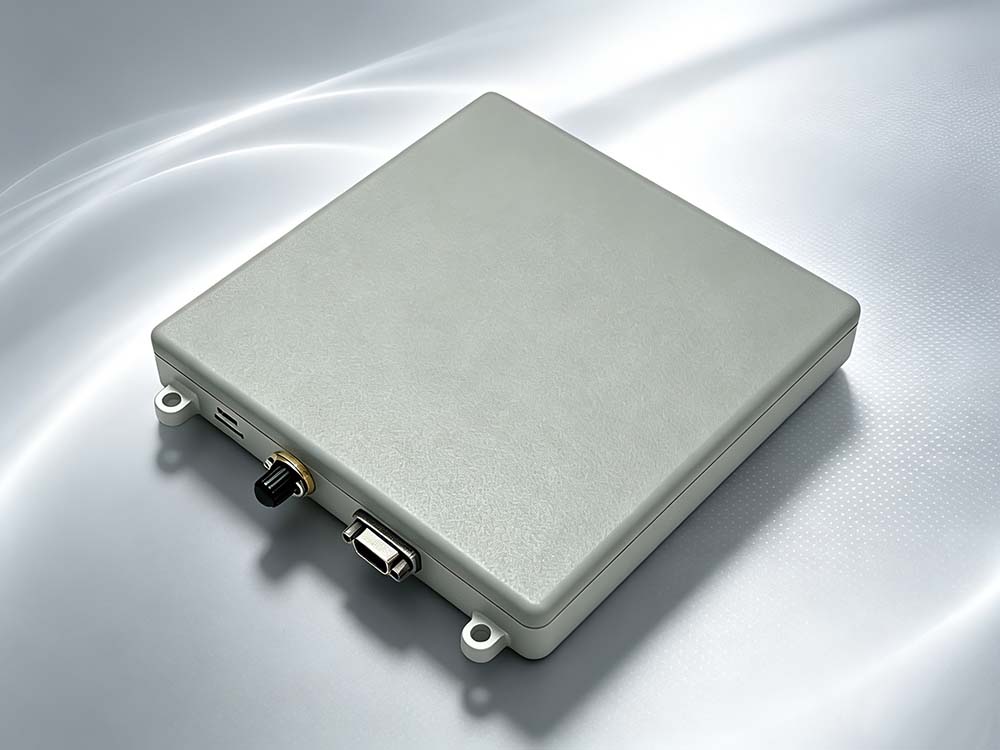
The antenna works across two independent bands: BDS-B1, GPS-L1, and Galileo-E1 on the first band, and BDS-B3 on the second. Each band uses its own four-element array and can form spatial nulls toward up to three interference directions simultaneously. That means L1 interference does not affect B3 tracking, and vice versa. The unit accepts 9–36 VDC and draws about 18 watts. It outputs NMEA0183 over RS422 at 115200 baud plus 1PPS, with a 3.3V LVTTL UART available for integration.
Field Results and Data
During a controlled test at the scenic area, the team placed three jammers around the launch zone at different angles: one broadband noise source on L1, one pulsed signal on B3, and one swept-frequency jammer covering both bands. With the standard GNSS antennas, the ground station lost valid positioning within seconds, and most nearby drones reported a position error above 50 meters.
With the BNTDFE4A installed on the lead drones and the ground reference unit, the same interference scenario did not interrupt navigation. The positioning remained stable, and the fleet completed three full rehearsal flights without a single GNSS-related abort. The anti-jam processor consistently rejected single-interference signals at better than 110 dB and three simultaneous interference sources at better than 95 dB. In practice, that allowed the receiver to keep tracking satellites even when the jamming signal at the antenna input was far stronger than the GNSS signal.
Power consumption stayed at 18 watts during active nulling, and the wide 9–36 VDC input worked directly with the team’s 6S LiPo packs without extra regulation. Because the antenna is only 20 mm thick, it mounted flat on the drones using the standard 160×120 mm hole pattern. The added 670 grams reduced flight time by less than 2 percent on the larger lead units.
Project Value
The upgrade removed the main operational risk for the show. Before installing the BNTDFE4A, the team had to cancel or postpone performances whenever interference appeared. After integration, the show ran on schedule for the entire trial period. The dual-band design gave an extra layer of safety: if one band was jammed, the other kept providing position data independently.
For the operator, the value was not just avoiding revenue loss from canceled shows. It was also about safety. In a dense formation over water, losing GNSS on a few drones can cause collisions or crashes into the audience area. The BNTDFE4A reduced that risk by handling both accidental and intentional interference before the navigation receiver could be affected.
This case shows that production-ready anti-jam hardware is no longer limited to military applications. The BNTDFE4A fits into commercial UAV operations where spectrum is congested and a single cheap jammer can still ruin the night.