
Selecting a GNSS anti-jamming antenna is a systems engineering task. It affects satellite availability, position accuracy, and resistance to both broadband noise and narrowband jamming. A unit that looks strong on a datasheet may fail once installed on a vehicle roof, UAV frame, or naval mast.
A GNSS anti-jamming antenna is not a generic GPS patch. It must reject interference while preserving weak satellite signals. The selection process should involve RF engineers, platform integrators, and procurement staff early.
Begin With the Interference Profile
Map the expected threat before comparing products. Is the risk continuous-wave jamming, swept interference, pulsed signals, or spoofing? Record frequency bands, incident power, and angle of arrival. This profile determines whether a fixed radiation pattern antenna is enough or whether a controlled reception pattern antenna (CRPA) array is required. For related receiver selection, see our military anti-jamming GPS receiver guide.
Compare Antenna Architectures
Different GNSS anti-jamming antenna designs solve different problems. Use the table below as an initial filter.
| Architecture | Best Use | Nulling Potential | Main Trade-off |
|---|---|---|---|
| Fixed pattern | Low threat, cost-sensitive | Low | No adaptive nulls |
| Dual-polarized | Multipath and simple jamming | Moderate | Limited spatial filtering |
| CRPA array | High threat, dynamic platforms | High | Size, cost, calibration |
| Multi-band array | L1/L2/L5 protection | High | Complex RF chain |
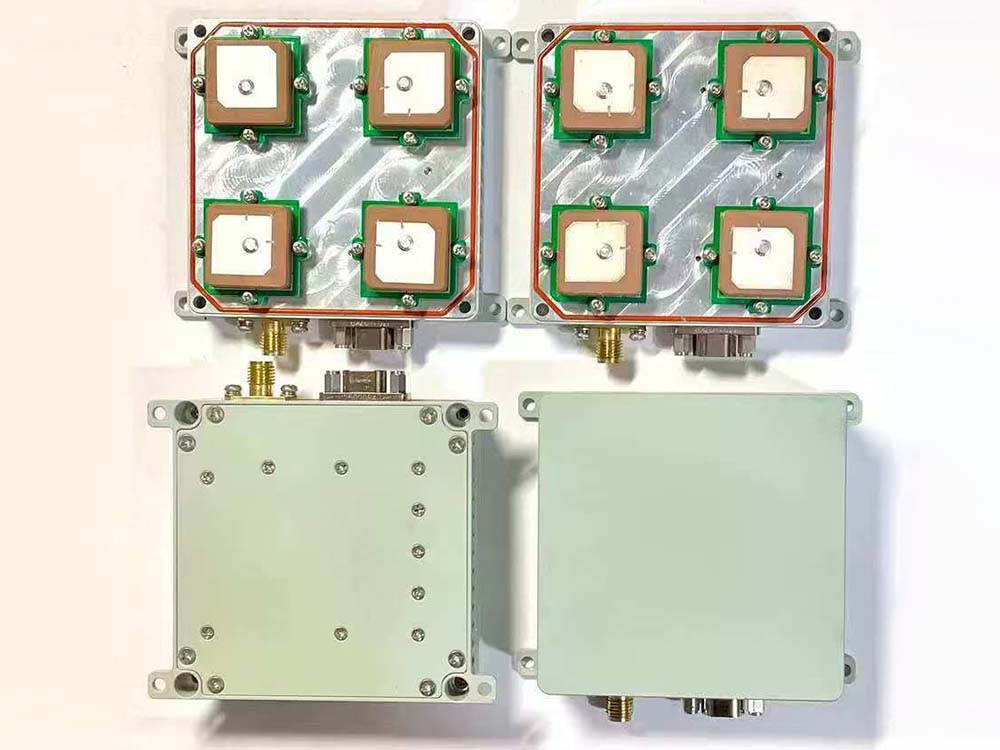
A CRPA-based GNSS anti-jamming antenna can place nulls toward interferers. However, it needs accurate calibration and a clear installation plan.
Match RF Metrics to the Mission
Check gain, axial ratio, bandwidth, and noise figure. For anti-jamming work, also demand nulling depth, beamforming speed, and channel consistency. A typical military-grade unit targets 30–50 dB nulling, but performance depends on array size and signal environment. Polarization purity matters because cross-polarization loss reduces effective sensitivity. Ask for S-parameters, radiation patterns, and phase stability data.
For multiband receivers, phase center stability across L1, L2, and L5 is also important. Otherwise, correction services may lose accuracy.
Mounting, Grounding, and Cabling
Installation changes performance. Metal surfaces, nearby antennas, and cable loss can shift phase and reduce nulling. Keep RF cables short and phase-matched. Ground the antenna according to the platform’s EMI plan. For airborne or vehicle systems, verify vibration and shock ratings. A GNSS anti-jamming antenna that passes bench tests may still fail under dynamic motion if mounting is weak.
Use torque values from the antenna vendor and inspect connectors after installation.
Validation and Acceptance
Require live-sky tests with representative jammers. Measure time-to-first-fix, carrier-to-noise density, position error, and reacquisition time. Test multiple jamming angles and power levels. Compare results with the vendor’s compliance matrix. External references such as GPS.gov performance standards and ITU-R interference guidance can help frame test criteria. Document every test; acceptance evidence protects both integrator and end user.
If possible, run a two-antenna baseline test to confirm phase matching and common-mode rejection.
Final Procurement Notes
Request calibration certificates, export classification, and long-term availability. Confirm firmware support and repair turnaround. Ask whether the vendor provides installation training and on-site support. If the quotation omits nulling data or phase matching, treat it as incomplete.
Choosing a GNSS anti-jamming antenna demands threat data, RF evidence, and installation discipline. Start with the interference profile, compare architectures, then validate in the field. This sequence reduces costly redesign and protects PNT integrity.
Keep a copy of all test data with the purchase order. Review results against the original requirements before final payment.