
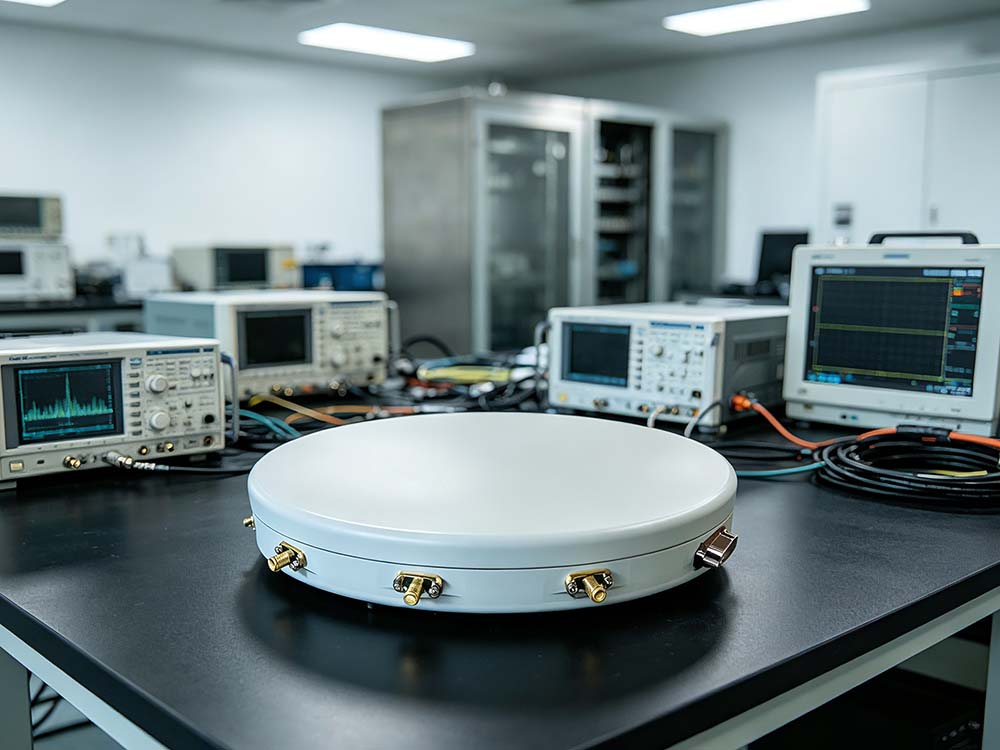
Military Grade Anti-Jamming GPS Receiver is not a commercial GPS unit with a rugged case. It is an integrated RF system that detects, characterizes, and suppresses interference before signals reach the navigation processor.
Why Military Grade Anti-Jamming GPS Receiver Matters
In contested electromagnetic environments, jamming can deny position, navigation, and timing (PNT) within seconds. A Military Grade Anti-Jamming GPS Receiver uses adaptive nulling, beamforming, and filtering to preserve satellite lock. The difference between a commercial module and a military-grade receiver appears in jammer-to-signal ratio, convergence time, and environmental durability.
Core Performance Benchmarks
Buyers should demand measured data, not datasheet claims. A Military Grade Anti-Jamming GPS Receiver typically provides 40–60 dB nulling depth, supports multiple constellations, and maintains tracking under high dynamic stress. Key metrics include:
-
Nulling depth: 40–60 dB
-
Convergence speed: below 1 ms
-
Concurrent jammers suppressed: 4–8
-
Operating temperature: -40°C to +85°C
-
Anti-spoofing: optional but recommended
These figures separate true military-grade hardware from industrial GPS receivers that merely add metal shielding.
Environmental qualification also matters. A receiver certified to MIL-STD-810H and MIL-STD-461G has passed vibration, shock, humidity, and electromagnetic compatibility testing. Those certificates add cost, but they reduce field failure risk.
Selection Matrix: Grade vs. Capability
| Tier | Nulling Depth | Typical Platform | Integration Effort |
|---|---|---|---|
| Entry military | 30–40 dB | Dismounted radios | Low |
| Standard military | 40–50 dB | Vehicles, UAVs | Medium |
| High-end military | 50–60 dB | Aircraft, naval | High |
| Special mission | 60+ dB | Strategic assets | Very high |
A Military Grade Anti-Jamming GPS Receiver in the high-end tier often uses controlled reception pattern antenna (CRPA) arrays. These arrays create nulls toward interferers while preserving satellite signals from other directions.
Deployment Scenarios and Integration Notes
For armored vehicles, a Military Grade Anti-Jamming GPS Receiver must tolerate vibration, shock, and wide voltage swings. For unmanned systems, size, weight, and power (SWaP) become the limiting factors. Integrators should request an interface control document (ICD) before quotation. For broader RF procurement context, see our anti-jamming module quotation guide. External references such as GPS.gov performance standards and NIST time and frequency resources provide useful background.
Mounting, cabling, and antenna placement can change effective nulling performance. A receiver that performs well on a test bench may degrade when installed near high-power transmitters or reflective surfaces. Early integration testing is therefore essential.
[Image: Military Grade Anti-Jamming GPS Receiver with CRPA array — alt text: Military Grade Anti-Jamming GPS Receiver installed on armored vehicle]
[Video: live-sky jamming test with adaptive nulling — 2:14]
Procurement Red Flags
A quotation that omits jammer-to-signal ratio, nulling depth, or calibration data should be treated as incomplete. Other red flags include no anti-spoofing option, unclear export classification, and no field test report. Vendors who cannot provide a compliance matrix often outsource core RF design.
Verification Steps Before Fielding
Before accepting a Military Grade Anti-Jamming GPS Receiver, run live-sky tests with representative jammers. Verify convergence time, reacquisition after signal loss, and behavior under multiple simultaneous threats. Confirm that firmware updates and key management meet your security framework. Document results and compare against the original quotation.
Laboratory and Field Validation
Laboratory tests should include continuous-wave, swept-frequency, and pulsed jamming. Field validation should cover dynamic motion, urban canyons, and wooded terrain. Record time-to-first-fix, position error, and reacquisition latency. These records become your acceptance evidence.
Lifecycle and Support
Long-term support affects total ownership cost. Ask about firmware updates, repair turnaround, spare parts, and end-of-life notices. A receiver with strong documentation and training materials reduces operator error. Budget for periodic calibration and antenna inspection as well.
Conclusion
Selecting a receiver requires technical evidence, not brand claims. Focus on nulling depth, convergence speed, SWaP, and support. A disciplined evaluation protects PNT integrity in the field.