
Picking an anti-jamming antenna for a UAV is not a “more gain is better” decision. It is a system decision. The antenna has to fit the jamming threat, the GNSS receiver, the airframe, and the way the aircraft actually flies.
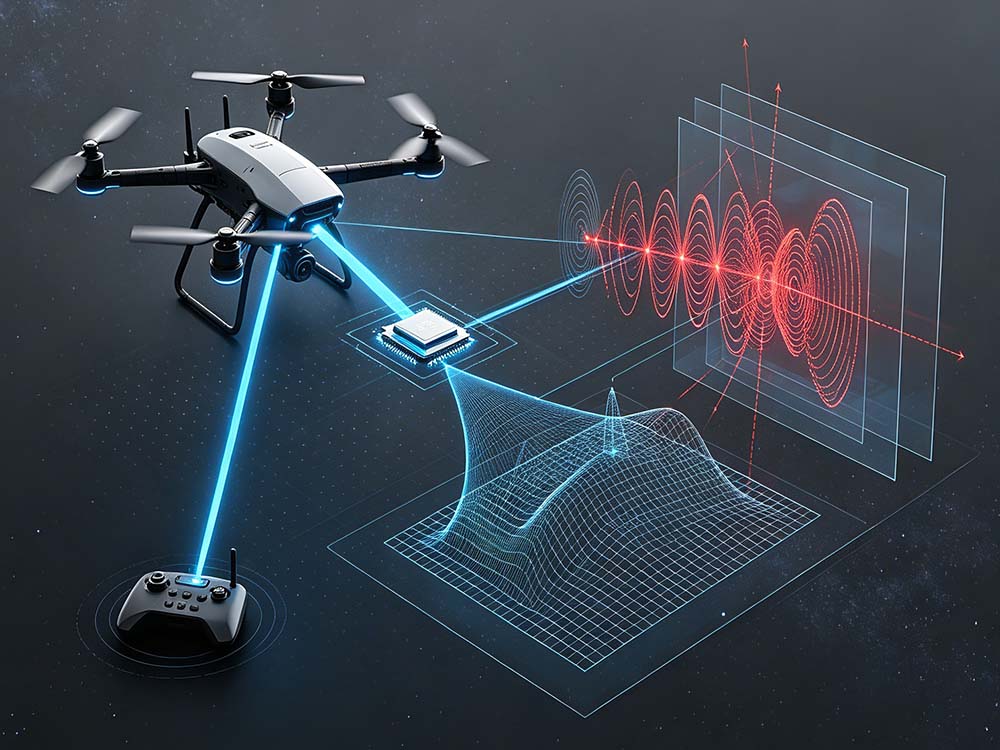
A unit that performs well on a ground vehicle may be too heavy, too power-hungry, or poorly phased for a small drone. A lightweight patch that works in clean skies may fall apart under a broadband jammer. The right choice usually comes from a short list of hard questions.
Start with the threat, not the datasheet
Before comparing models, write down what the UAV is likely to face.
-
Broadband noise jamming: raises the noise floor across GNSS bands.
-
Narrowband or sweep jamming: hits one frequency or moves across bands.
-
Spoofing: sends fake signals that look real.
-
Multipath and interference: reflections from buildings, terrain, or onboard electronics.
That list changes the antenna class. If the problem is mostly unintentional interference, filtering, shielding, and a good low-noise active antenna may be enough. If the problem is intentional jamming, you likely need a Controlled Reception Pattern Antenna (CRPA) or another adaptive array that can steer nulls toward the jammer. For spoofing, the antenna alone is not a full answer. You also need receiver authentication, inertial aiding, or both.
The specs that actually change flight outcomes
Datasheets are useful, but they are not flight results. These are the parameters worth comparing side by side.
| Factor | What to check | Why it matters |
|---|---|---|
| Frequency coverage | L1/L2/L5, E1/E5/E6, B1/B2, and other GNSS bands | Must match the receiver and the jamming threat |
| Polarization | RHCP, axial ratio, cross-polar rejection | Better satellite signal and less multipath |
| Gain and pattern | Active gain, beamwidth, roll-off at low elevation | Coverage without amplifying noise |
| Nulling performance | Number of elements, null depth, DOA speed, settling time | Direct measure of anti-jam capability |
| SWaP | Weight, dimensions, power draw | Affects endurance, payload, and thermal design |
| RF interface | Connector type, impedance, phase-matched cables | Cable loss and phase errors can kill array performance |
| Environment | Temperature, vibration, IP rating, altitude | Reliability in real flight conditions |
| Receiver fit | Gain, AGC range, voltage, filtering | Prevents saturation and receiver desensitization |
A CRPA with 40 dB nulling in a lab may deliver far less once installed on a small airframe. Ground plane, cable routing, radome material, and nearby datalink antennas all change the pattern. That is why integration testing matters as much as the spec sheet.
Match the antenna to the mission
There is no single best anti-jamming antenna for every UAV. The mission profile should drive the trade-offs.
| Mission type | What to prioritize | Practical direction |
|---|---|---|
| Small tactical recon | Low SWaP, dual-band L1/L2 | Lightweight active patch or compact 2-element array |
| Long-endurance ISR | Multi-band coverage, low power, stable nulling | Tri-band CRPA with efficient electronics |
| Urban operations | Multipath rejection, good axial ratio | Filtered dual/tri-band antenna with null steering |
| GNSS timing or critical navigation | Anti-spoof robustness, high availability | CRPA plus inertial or receiver-level authentication |
| Swarm or attritable UAV | Cost, size, repeatability | OEM antenna module with simple calibration |
For small drones, weight and power often win. For larger ISR platforms, multi-band nulling and receiver compatibility usually matter more. For swarms, cost and repeatability can outweigh maximum null depth.
Installation is where many designs lose performance
You can buy a strong antenna and still get weak results. Common installation issues include:
-
Poor ground plane: changes gain, pattern, and axial ratio.
-
Long or lossy RF cables: reduces signal and adds phase error.
-
Unmatched cable lengths in arrays: destroys nulling accuracy.
-
Bad placement: puts the antenna near motors, cameras, or datalink radios.
-
Vibration and flexing: shifts phase center or loosens connectors.
-
No calibration: leaves adaptive nulling working with wrong assumptions.
For CRPA systems, phase stability is not a detail. It is the product. If the cables and connectors are not phase-matched and stable over temperature, the array cannot form reliable nulls.
Test like you fly
Bench tests are necessary, but they are not enough. A sensible validation plan includes:
-
Anechoic chamber testing: gain, pattern, axial ratio, and nulling.
-
Live-sky static test: C/N0, TTFF, and position accuracy.
-
Field jammer test: different jammer types, angles, and power levels.
-
Dynamic flight test: vibration, banking, multipath, and body blockage.
-
Receiver-level checks: AGC behavior, saturation, and reacquisition time.
Track metrics such as C/N0, position error, availability, time to first fix, and null depth. A antenna that looks good on a spectrum analyzer may still fail when the UAV banks and the jammer moves.
Common buying mistakes
-
Choosing the highest gain instead of the best pattern.
-
Ignoring receiver AGC and front-end saturation.
-
Using cheap cables in a phase-critical array.
-
Assuming lab nulling equals installed nulling.
-
Forgetting export controls such as ITAR or EAR.
-
Leaving antenna placement until the airframe is already frozen.
A quick selection checklist
-
What jamming and spoofing threats are realistic?
-
Which GNSS bands must be covered?
-
How much weight and power can the UAV spare?
-
Does the receiver need active gain, filtering, or both?
-
Is a single antenna enough, or is a CRPA required?
-
Can the airframe provide a stable ground plane?
-
Are cables phase-matched and routed away from noise sources?
-
Has the full system been tested with a jammer in the field?
Bottom line
The best anti-jamming antenna for a UAV is the one that matches the threat, fits the platform, works with the receiver, and survives real flight testing. Start with the mission, not the marketing. Then compare bands, nulling, SWaP, and integration support. If you remember one thing, remember this: the antenna is only as good as the system around it.