
The 4-element vs 7-element CRPA antenna debate usually starts with a simple question: how much interference do you really need to survive? More elements sound better. In a lab, they often are. On a real platform, the answer gets messier—because every extra RF channel adds size, power, calibration work, and cost.
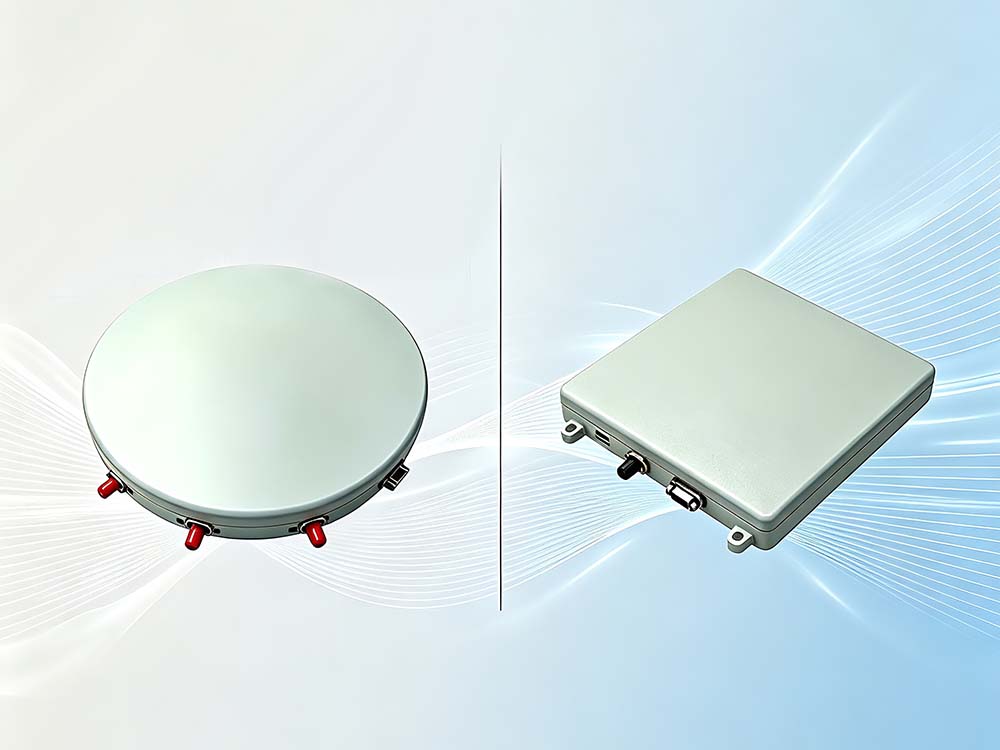
A controlled reception pattern antenna (CRPA) uses an array and adaptive processing to steer nulls toward jammers while keeping GNSS signals usable. The element count sets the theoretical degrees of freedom. It does not, by itself, guarantee better anti-jamming performance. Array geometry, RF chain quality, calibration, and processing algorithms still decide what happens in the field.
What element count changes
Think of each element as a tool. A 4-element array gives you four RF chains. A 7-element array gives you seven. In theory, an N-element adaptive array can place up to N−1 nulls. In practice, constraints—beamforming requirements, polarization, mutual coupling, calibration errors, and multi-frequency operation—eat into that number.
So a 4-element CRPA may reliably suppress one or two jammers in a demanding scenario. A 7-element CRPA can take on more threats and still have room to shape the beam. That extra margin matters when the RF environment is dense or changing quickly.
4-element CRPA: compact and focused
A 4-element CRPA is often the practical choice for platforms where SWaP—size, weight, and power—is tight. UAVs, small naval craft, land vehicles, and some portable systems fall into this group. It is easier to mount, easier to cable, and easier to calibrate. The processing load is lower, and the antenna itself usually costs less.
But don’t mistake “compact” for “weak.” A well-designed 4-element array can handle common jamming threats, especially when the interference comes from a limited number of directions. If the mission is single-band or dual-band GNSS with moderate interference, it can be the smarter buy.
7-element CRPA: more tools, more responsibility
A 7-element CRPA shines when the platform cannot afford to lose GNSS. High-value defense assets, multi-mission aircraft, and ships facing complex electronic warfare often need the extra degrees of freedom. With seven channels, the system can suppress more jammers, handle more dynamic scenarios, and still preserve useful gain toward satellites.
The catch is integration. Seven channels mean seven matched RF paths, more connectors, more data, and a heavier processor. Calibration becomes less forgiving. A small phase or amplitude error across channels can reduce null depth. The antenna also needs a larger, more stable ground plane to perform as modeled.
Side-by-side comparison
| Criteria | 4-element CRPA | 7-element CRPA |
|---|---|---|
| RF channels | 4 | 7 |
| Theoretical degrees of freedom | 3 | 6 |
| Typical nulling capacity | 1–3 jammers, depending on constraints | 3–6 jammers, with more margin |
| Size and weight | Smaller, easier to integrate | Larger, needs more space and ground plane |
| Power and heat | Lower | Higher |
| Calibration | Simpler | More complex; channel matching is critical |
| Cost | Lower BOM and integration cost | Higher BOM, test, and lifecycle cost |
| Best fit | UAVs, vehicles, small vessels, moderate threats | High-value platforms, dense interference, multi-threat missions |
| Main trade-off | May run out of degrees of freedom | Pays in SWaP, cost, and integration effort |
The hidden costs of more channels
The anti-jamming antenna is only one line on the BOM. A 7-element CRPA pulls in more RF cables, more digitizers, more processing, and more testing. It also takes longer to install and validate. On a space-constrained platform, the extra channels can force changes to the radio rack, cooling, and cabling.
That is why a 7-element system can look superior on a datasheet and still be the wrong choice for a program. If the threat is limited and the platform is small, the extra performance may never be used. If the threat is dense and the mission is critical, the 4-element system may hit its limit at the worst possible time.
Platform fit: where each one earns its place
For a UAV or a small patrol vehicle, a 4-element CRPA often hits the sweet spot. It keeps weight down, reduces power draw, and leaves room for other payloads. For a frigate, command vehicle, or large aircraft, a 7-element CRPA can make sense because the platform can carry the extra hardware and the mission justifies the cost.
The RF environment matters just as much. One strong jammer from a known direction is a different problem from multiple jammers, multipath, and rapidly changing angles of arrival. The first may be handled by a 4-element array. The second is where a 7-element array starts to earn its keep.
A practical selection checklist
-
How many simultaneous jammers must the system defeat?
-
Are they narrowband, broadband, or both?
-
Does the platform need multi-constellation and multi-frequency operation?
-
What are the size, weight, power, and cooling limits?
-
Is there enough ground plane for a larger array?
-
Can the installation support tight phase and amplitude calibration?
-
What is the lifecycle cost, not just the antenna price?
-
How will the system be tested—chamber, live sky, or record-and-replay?
Final take
The 4-element vs 7-element CRPA antenna choice is not a simple “more is better” decision. A 7-element array gives you more degrees of freedom and more room to fight complex interference. A 4-element array gives you a smaller, cheaper, and often sufficient solution for moderate threats.
Buy the array that matches the threat, the platform, and the budget. If you can, test both in the actual RF environment. The best CRPA is the one that keeps GNSS working without breaking the platform around it.