
How does a CRPA antenna work? A Controlled Reception Pattern Antenna (CRPA) is not a conventional GNSS antenna. Instead of accepting every signal that reaches its aperture, it continuously shapes its reception pattern to favor satellite signals and reject interference. That ability makes CRPA systems valuable in defense, aviation, and other environments where even brief GNSS disruption is unacceptable.
At its core, a CRPA is an antenna array combined with a real-time signal-processing engine. The array may contain two, four, seven, or more elements. Their physical spacing and geometry are known, which allows the system to compare the same incoming wave across multiple channels. The processor then adjusts amplitude and phase weights before combining those channels into one output for the GNSS receiver.
From RF Capture to Weighted Output
The processing chain is methodical. Each antenna element feeds a dedicated RF channel with filtering, amplification, downconversion, and analog-to-digital conversion. Calibration corrects gain and phase mismatches between channels; without it, the array cannot distinguish true direction from internal error. The digital processor then estimates the spatial covariance of the received signals. In simple terms, it learns where energy is arriving from and how strong it is.
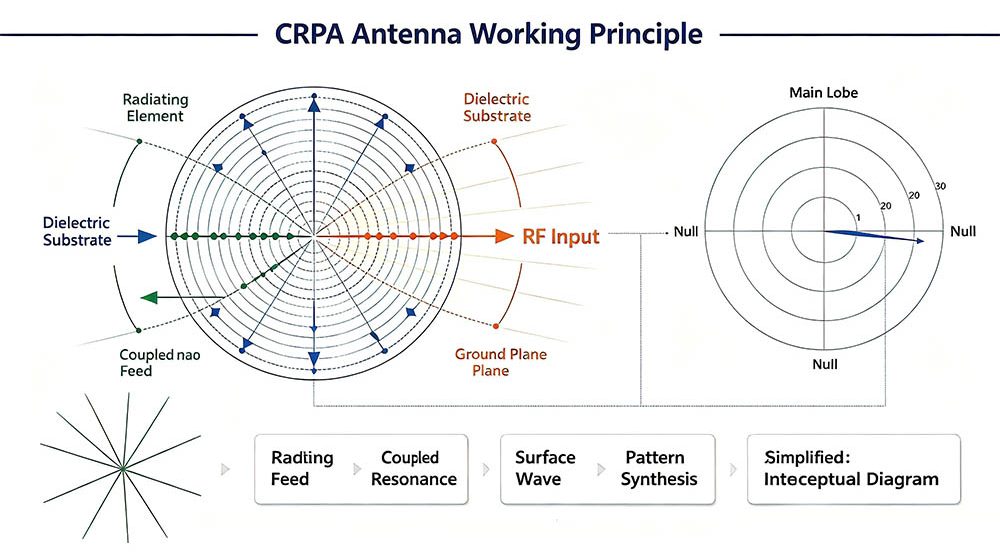
Next, an adaptive algorithm calculates weights. A common approach is minimum variance distortionless response (MVDR), which minimizes total output power while preserving gain in desired directions. Other implementations may use power inversion or subspace methods. The weights are applied to each channel and summed. Because interference from a specific direction adds constructively in some channels and destructively in others, the array can place a null toward the jammer while maintaining usable gain toward satellites.
| Function | What It Does | Why It Matters |
|---|---|---|
| Element array | Captures GNSS and interference across spaced phase centers | Provides spatial separation needed for direction finding |
| Calibration | Corrects channel gain/phase differences | Prevents false nulls and signal loss |
| Covariance estimation | Measures signal and interference statistics | Gives the processor a real-time interference map |
| Adaptive weighting | Computes complex weights per element | Balances satellite gain against jammer suppression |
| Null steering | Places low-gain directions toward interferers | Reduces jamming power before the receiver |
| Beamforming | Shapes main lobe toward GNSS signals | Improves carrier-to-noise ratio |
| Receiver integration | Passes combined RF/digital stream to GNSS receiver | Enables tracking, timing, and positioning |
Beamforming, Nulling, and Limits
The term “controlled reception pattern” refers to this dynamic control. A CRPA can form a beam toward one or more satellites while steering nulls toward jammers. With M elements, a system can typically create up to M−1 independent nulls, depending on algorithm and calibration quality. More elements mean more degrees of freedom, but also greater size, cost, power demand, and processing complexity.
CRPA is primarily a GNSS anti-jam technology. It can reduce narrowband and broadband interference, including some multipath, but it is not a complete anti-spoofing solution. Spoofing signals may arrive from directions similar to legitimate satellites, so CRPA is often paired with signal authentication, inertial navigation, and receiver-level monitoring.
Practical Engineering Considerations
Real-world performance depends on antenna geometry, calibration stability, RF chain linearity, and algorithm latency. A CRPA must update weights quickly enough to follow moving platforms and changing interference, yet not so aggressively that it suppresses weak GNSS signals. Installation matters too: platform reflections, cable phase drift, and nearby antennas can distort the array response. Testing therefore combines anechoic chamber measurements, live-sky trials, and controlled jamming scenarios.
Conclusion
How does a CRPA antenna work? A CRPA antenna works by turning spatial diversity into GNSS interference mitigation. Multiple elements capture the wavefield; calibration and adaptive processing estimate interference; weighting and null steering suppress jammers; and the combined output gives the GNSS receiver a cleaner signal. It is not magic—it is disciplined RF engineering—but in contested electromagnetic environments, that discipline is often what keeps positioning and timing available.