
A container terminal on China’s eastern coast handles about 4,000 gate moves a day. Its automation and security teams rely on GNSS time synchronization for crane positioning, gate cameras, access control, and vessel traffic monitoring. For two years, the terminal saw intermittent faults: camera timestamps drifted by several seconds, the gate system occasionally rejected valid driver IDs because time windows mismatched, and one ship-to-shore crane lost position lock during a night shift. The root cause was later traced to low-cost GPS jammers used by drivers hiding vehicle trackers and by nearby construction crews testing RF gear. The port needed a compact anti-jamming solution that could mount on poles or container office roofs without adding rack-mount hardware.

Project background and pain points
The existing GNSS receivers used standard active antennas with no interference suppression. When a jammer passed within 300 meters, even for a few minutes, the timing server slipped into holdover. If holdover stretched long enough, the CCTV timeline became unreliable for incident investigations. The port looked at several CRPA arrays, but most were too heavy or required external downconverters and receiver chains. The BNT2504 7-element anti-jamming antenna was selected because it combines a seven-element array, anti-jamming processor, and full-band navigation receiver in a Φ220 mm × 29.5 mm housing weighing under 1.2 kg.
Purchased antenna specifications
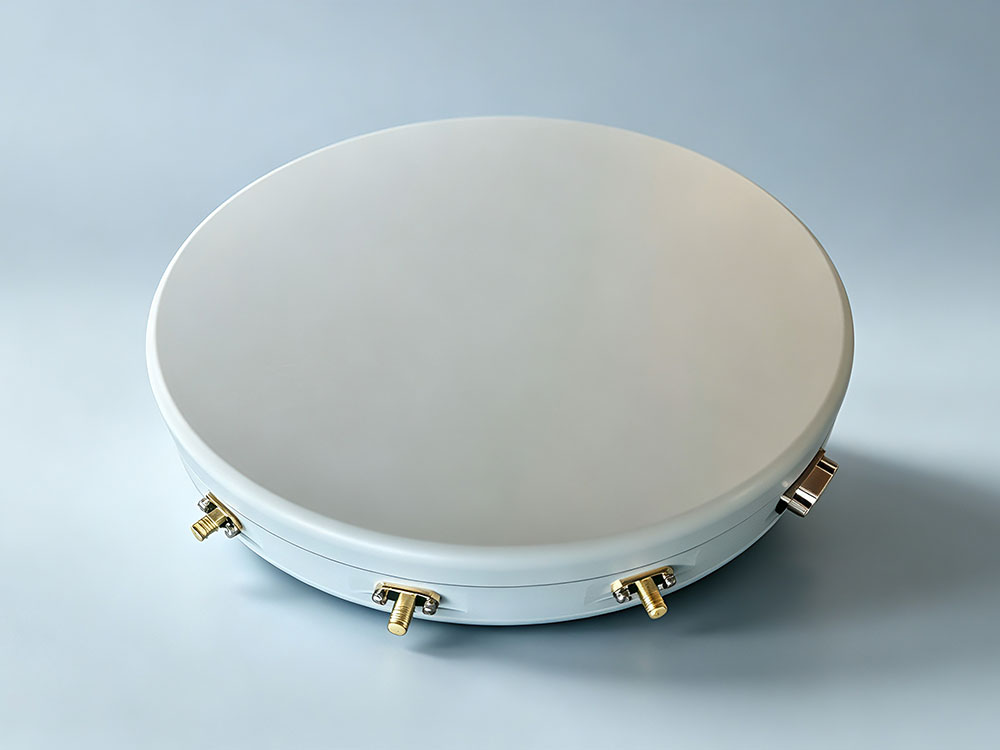
The port installed two BNT2504 units with the following configuration:
-
Model: BNT2504 7-Element Anti-Jamming Antenna: 6-Jammer Blocker
-
Reception: BDS-B1i/B1c, GPS-L1, GLONASS-G1, Galileo-E1
-
Array: 7 elements, up to six spatial nulls
-
Jammer suppression: ≥120 dB single-tone; ≥110 dB with three jammers; ≥100 dB with six active jammers
-
Interference types: narrowband, broadband, pulsed, swept, Gaussian; CW tolerance ≥10 W
-
Outputs: NMEA 0183 via anti-jamming UART and SMA RF at −60 to −40 dBm, mutually exclusive
-
Power: 6–33 V DC through XT30, 25 W maximum draw
-
Accuracy: ≤1.5 m horizontal, ≤0.2 m/s velocity, ≤100 ns timing (95%)
-
Operating range: −40 °C to +55 °C
Actual operation and data
The first BNT2504 units were installed on the timing rack near the gate office and on a crane monitoring pole. In a controlled test, six portable jammers were placed 20 to 80 meters from the timing rack. The BNT2504 held NMEA output with timing accuracy within 93 ns, and horizontal position stayed under 1.4 m. With three swept jammers, velocity error remained at 0.18 m/s. When two broadband and four narrowband sources ran at the same time, the module kept lock and the timing server recorded no holdover events during a four-hour test. Over three months of normal operation, camera timestamp drift dropped from several seconds per week to under 20 ms weekly. The gate system’s false rejection rate fell to zero. Power draw stabilized between 18 W and 22 W. A passing truck with an active 2 W jammer caused no loss of lock at the gate office.
Project value
The port now has clean PNT under stress without replacing existing controllers or running new RF cable. The six-null suppression handles the interference types seen near truck lanes and container yards. Because the BNT2504 outputs standard NMEA 0183 sentences, existing timing boards read position, velocity, and time directly. Maintenance staff can swap a unit in minutes using M3 screws. The same model also fits the port’s planned unmanned ground vehicles for yard patrols. Total cost stayed below a rack-mounted anti-jam system, and the terminal avoided timing outages during the following peak season. The port has since ordered four more units for backup timing nodes and a patrol vessel. For ports and coastal facilities that depend on GNSS time and video monitoring, the BNT2504 provides a practical, compact defense against real-world RF interference.