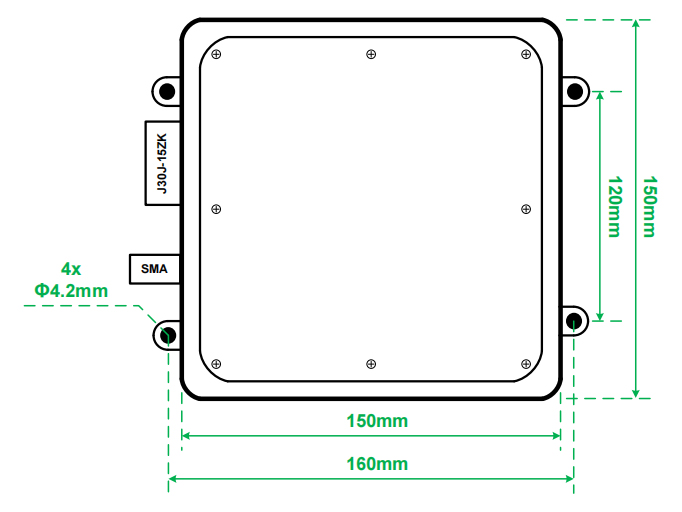
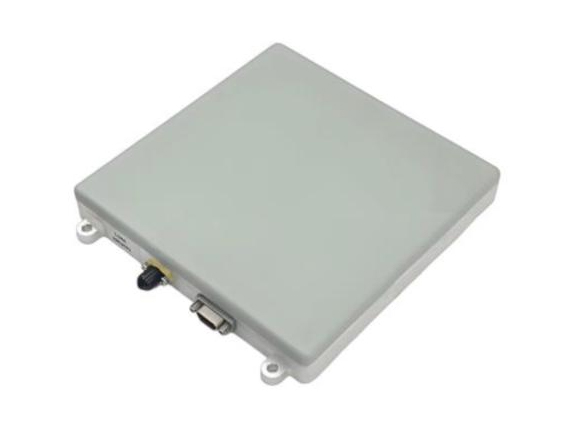
The satellite navigation 8-element anti-jamming antenna BNTSN8EA targets one specific failure mode: losing GNSS lock because someone nearby is broadcasting noise. Most jammers are cheap. Losing position data during a flight or mission is not. This unit packs an eight-element array, the anti-jam processor, and a Ublox X20P receiver into a 670-gram housing that measures 170×150×20 mm.
It covers L1, B1, G1, and E1 frequencies in a single band. That means GPS, BDS, GLONASS, and Galileo all get the same spatial filtering treatment. No separate modules. No external cabling between array and receiver.
Why Eight Elements Change the Math
A four-element array can create up to three spatial nulls. An eight-element array creates up to seven. That is the entire difference. The BNTSN8EA uses its extra elements to place independent nulls on seven different incoming interference directions simultaneously.
In practice, that means a drone flying near a contested border does not lose navigation because three jammers are on one side and four are on another. Each jammer gets its own null. The satellite signals from other directions still pass through.
For a deeper explanation of adaptive null steering in GNSS arrays, see this overview from Inside GNSS.
Jamming Waveforms the BNTSN8EA Rejects
The satellite navigation 8-element anti-jamming antenna handles broadband noise, narrowband tones, pulsed jammers, swept-frequency signals, and combinations of these. The spec sheet lists three performance tiers:
-
Single jammer: ≥110 dB rejection
-
Three jammers: ≥95 dB rejection
-
Seven jammers: ≥85 dB rejection
That last number matters. Most anti-jam products stop at three or four interferers. Seven-null capability is what makes this suitable for electronic warfare training ranges and high-value UAV operations. You can also check GPS World’s article on jamming trends for context on why multi-null arrays are becoming standard.
Electrical, Mechanical, and Data Interfaces
Power input runs from 9 to 36 VDC, so a 4S or 6S LiPo works directly. Rated consumption is 18 W. The connector is a J30J-15ZKP. Data comes out as NMEA0183 over RS422 at 115200 baud default, with a separate LVTTL UART and 1PPS line.
Mounting uses four 4.2 mm through-holes on a 160×120 mm pattern. The 20 mm profile keeps drag low on fixed-wing airframes.
If you need dual-band coverage, see our BNTDFE4A dual-band four-element unit for L1/B1/E1 plus B3 operation.
Interface Pinout
| Pin |
Code |
I/O |
Function |
| 1/2/3 |
VIN+ |
IN |
9–36 VDC power input |
| 4 |
RS422-RXP |
IN |
RS422 receive positive |
| 5 |
RS422-RXN |
IN |
RS422 receive negative |
| 6 |
RS422-TXP |
OUT |
RS422 transmit positive |
| 7 |
RS422-TXN |
OUT |
RS422 transmit negative |
| 8 |
GND |
— |
Ground |
| 9/10/11 |
GND |
— |
Ground |
| 12 |
UART-TX |
OUT |
LVTTL 3.3V transmit |
| 13 |
UART-RX |
IN |
LVTTL 3.3V receive |
| 14 |
GND |
— |
Ground |
| 15 |
PPS |
OUT |
1PPS, LVTTL 3.3V |