Overview
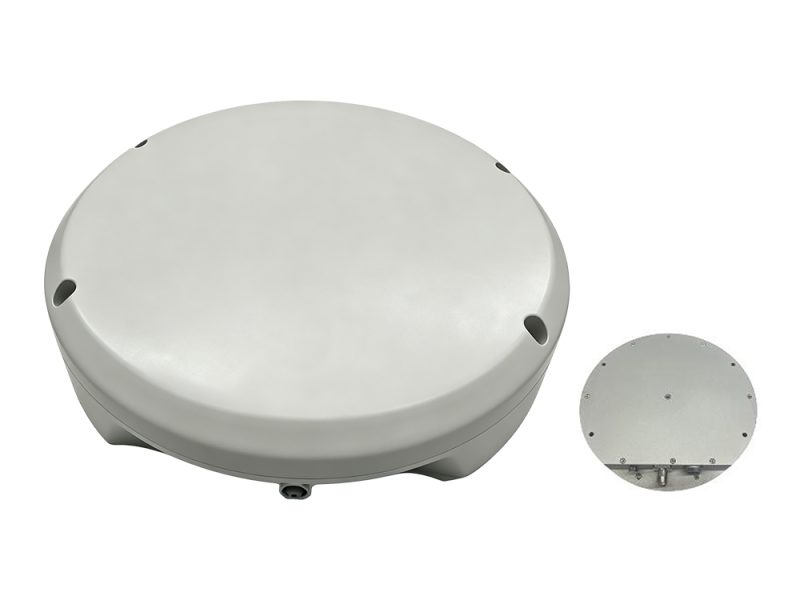
The BNTDFAT dual-band anti-jamming antenna targets shipborne, vehicle-mounted, and fixed critical-infrastructure GNSS reception. It handles broadband, narrowband, swept, pulsed, and combined suppression-style interference across two protected bands: GPS-L1/BDS-B1 and BDS-B3. The same unit also supports a bypass mode for L1/L2/L5, B1/B2/B3, E1/E5/E6, and G1/G2, so it remains useful when no jamming is present.
Array Architecture
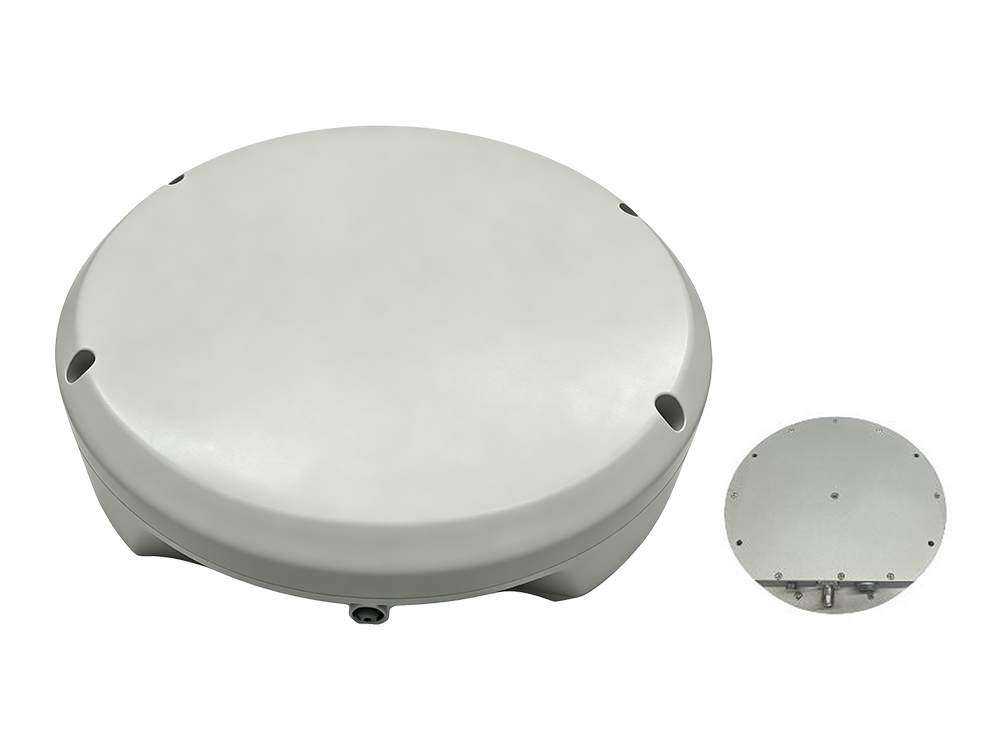
This dual-band anti-jamming antenna uses an 11-element array. Three central high-precision elements maintain standard navigation performance in clean RF conditions. Around them, two groups of four elements form independent spatial-nulling sub-arrays. When interference appears, these outer groups output two separate processed GNSS feeds. A manual switch moves the unit between anti-jam and direct pass-through modes.
Interference Rejection
Per protected band, the BNTDFAT can null up to three jammers arriving from different directions. Single-jammer rejection is at least 110 dB, while three simultaneous jammers still see over 95 dB of suppression. Supported threat types include broadband, narrowband, pulsed, swept, and combinations of these suppression-style jamming signals. The system updates nulls quickly enough for moving platforms, which matters on ships and vehicles where relative jammer angles shift continuously.
Receiver & Data Output
An integrated UM980 receiver is standard. Other receiver models can be customized on request. The unit outputs NMEA0183 over RS422 at 115200 baud default. A 1PPS LVTTL 3.3V signal is available on pin 14. If your host system already has a receiver, use bypass mode to feed raw GNSS signals directly through the antenna path.
Mechanical & Power Design
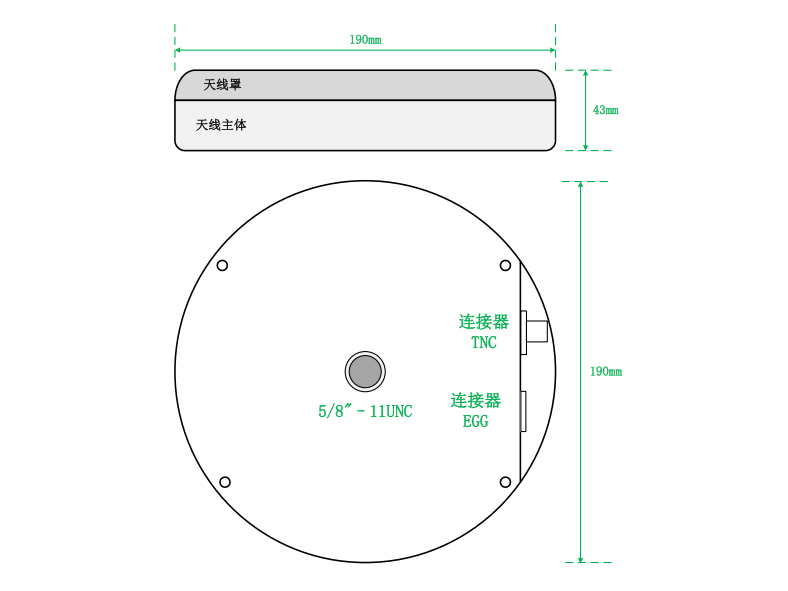
The package is 190 mm in diameter and 43 mm thick, weighing 1050 g. Input power is 12–36 VDC, with rated consumption of 20 W. Feed options include the TNC connector or the EGG.1K.314.CLL interface. Operating temperature spans -40°C to +70°C. This compact, lightweight build suits mast, roof, or deck mounting where space and payload are limited.
Applications
Naval vessels, armored vehicles, and mobile timing trailers operate in dense RF environments. The BNTDFAT dual-band anti-jamming antenna provides continuous PNT when intentional or unintentional jammers target L1 or B3 frequencies. Its dual-band capability means one antenna can protect both common civil and regional GNSS signals without switching hardware. This is especially useful for multi-constellation receivers that rely on GPS L1 and BDS B3 simultaneously.
Why Choose This Dual-Band Anti-Jamming Antenna
Most GNSS failures in contested environments happen because receivers lose lock on one or two bands. This dual-band anti-jamming antenna solves that by combining two protected bands, a bypass path, and an optional integrated receiver in a single enclosure. For programs needing low SWaP and high rejection, that integration cuts wiring, weight, and installation time. External resources like GPS.gov describe common interference sources.
Deployment Tips
As a dual-band anti-jamming antenna, the BNTDFAT should be mounted with a clear view of the sky and the antenna plane kept level. For DC feed, use pins 1–4 for VIN+ and pins 5–8 for GND. RS422 TX/RX pairs run on pins 9–12. Confirm baud rate and protocol before first power-on. If using the integrated UM980, store configuration profiles for quick replacement.
Performance Summary
-
Protected bands for this dual-band anti-jamming antenna: GPS-L1/BDS-B1 and BDS-B3
-
Array: 11 elements (3 center + 4+4 outer)
-
Jammers nulled: up to 3 per band, different directions
-
Rejection: ≥110 dB single, ≥95 dB triple
-
Bypass: L1/L2/L5, B1/B2/B3, E1/E5/E6, G1/G2
-
Receiver: UM980 integrated, customizable
-
Interface: RS422, NMEA0183, 1PPS LVTTL 3.3V
-
Power: 12–36 VDC, 20 W, TNC or EGG feed
-
Size/weight: Φ190 mm × 43 mm, 1050 g
-
Temperature: -40°C to +70°C
Connector Pinout